NSCT Test Pattern Explained
The NSCT is a computer-based test (CBT) sat at a centre in a 120-minute session, and your score is reported out of 100 (APP, 5 April 2026; HEC report). Questions cover 10 competency areas with fixed weightage, led by Problem Solving at 20% (Areas of Competencies), and HEC's report sorts them into three cognitive tiers: understanding, application and analysis.
What HEC has not published is just as important: the number of questions, any negative marking, and a passing mark. Those are covered at the end.
NSCT pattern at a glance
| Element | Official position | Source |
|---|---|---|
| Mode | Computer-based, at test centres | HEC |
| Duration | 120 minutes per session (2026) | APP |
| Sessions | 4 a day, 9:00 AM to 6:30 PM (2026) | APP |
| Score | Out of 100 | HEC report |
| Areas | 10 competency areas with set weightage | Areas of Competencies |
| Cognitive tiers | Understanding, Application, Analysis | HEC report |
| Question format | Objective, single-answer style (see below) | Not spelled out officially |
| Number of questions | Not announced | — |
| Negative marking | Not announced | — |
| Passing mark | Not announced | — |
Computer-based test (CBT)
The portal says Virtual University "shall serve as the testing body for conducting the computer-based test" (NSCT portal). You answer on a centre computer under invigilation, not on paper and not from home. In 2026 that meant 165 centres in 112 cities (HEC).
Question format. The official pages do not use the word "MCQ". However, HEC's report measures each tier by "accuracy" and says students "start guessing" on harder questions (HEC report). That language fits objective, multiple-choice style questions marked right or wrong, which is how we build our practice material. Treat it as the best reading of the evidence, not an official specification.
120 minutes per session
Official source
"The test was conducted on April 4 and 5, 2026, in four sessions per day, starting from 9:00 AM to 6:30 PM, with each session having a duration of 120 minutes." (APP, 5 April 2026)
Two hours across ten subject areas is not much. You need to recognise familiar question types fast, so that time is left for the analysis-tier questions. Our NSCT Test Day guide has a pacing plan.
Scoring out of 100
HEC reports NSCT scores out of 100. In 2026:
- The national average was 46.28 out of 100.
- The largest group, 10,324 candidates, scored in the 40–49 bracket.
- Only 13.6% scored 60 or above.
- Mapped to HEC's grading scale, 61.4% fell in the F bracket, and D and F together came to nearly 83%.
All figures: HEC NSCT report. These numbers show how the test was marked, not what a "pass" is. See NSCT Passing Marks for what is and is not known about passing.
The three cognitive tiers
HEC's report groups questions into three tiers and gives the national accuracy for each:
| Tier | What it tested (HEC's description) | 2026 accuracy |
|---|---|---|
| 1. Understanding | Basic recall, syntax and foundational definitions | 49.5% |
| 2. Application | Applying known rules to specific, constrained problems, such as executing a standard algorithm | 45.1% |
| 3. Analysis | Complex architecture, debugging and multi-step logic | 44.8% |
Source: HEC report. Even recall questions were answered correctly less than half the time. HEC reads the small gap between Application and Analysis as a sign that students guess once questions move beyond rehearsed textbook scenarios. Worked examples of each tier are on NSCT Question Types.
Weightage by competency area
| Competency area | Weightage |
|---|---|
| Problem Solving and Analytical Skills | 20% |
| AI / Machine Learning and Data Analytics | 10% |
| Computer Networks and Cloud Computing | 10% |
| Data Structures & Algorithms | 10% |
| Web Development | 10% |
| Software Engineering | 10% |
| Programming (C++/Java/Python) | 10% |
| Databases | 10% |
| Operating Systems | 5% |
| Cyber Security | 5% |
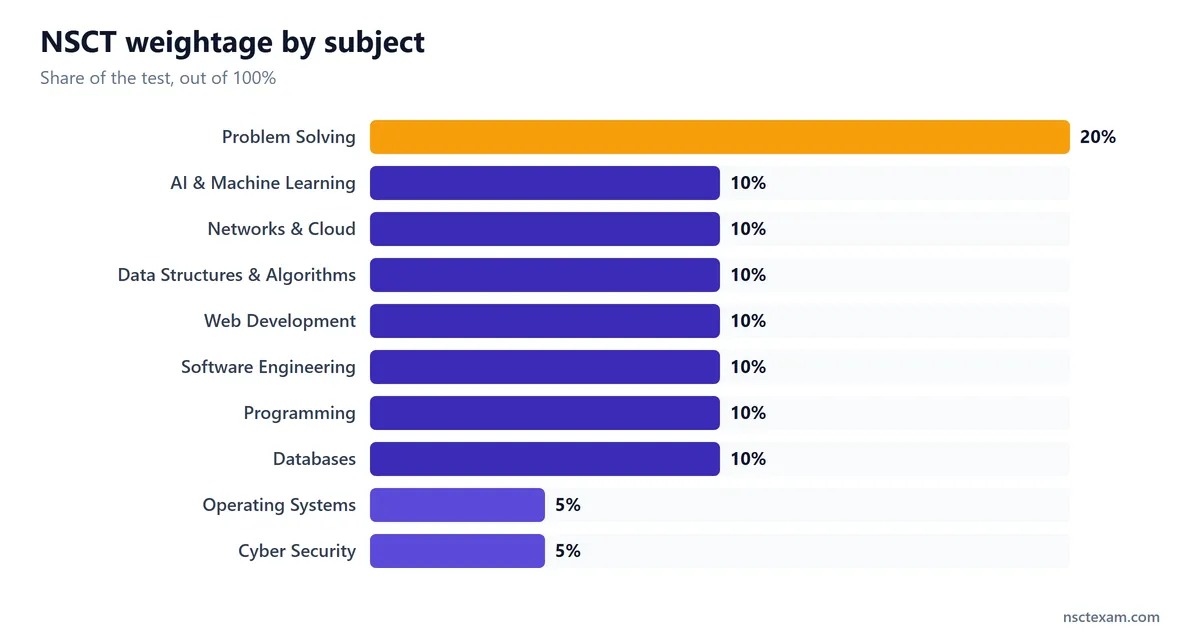
Source: Areas of Competencies. A Technical Committee led by P@SHA, with industry and academic members, finalised these areas (portal). For the full topic list see NSCT Syllabus, and for how to turn the weights into study hours see NSCT Syllabus Weightage by Subject.
What is not officially confirmed
- Number of questions: HEC has not officially announced the number of questions in the NSCT yet. Figures on other sites are not from HEC or VU.
- Negative marking: HEC has not officially announced any negative marking rule. Read the on-screen instructions on test day.
- Passing mark: HEC has not officially announced a passing mark or cutoff yet.
- Past papers: HEC has not officially released any NSCT past papers. Practice sets on this site are our own.
- 2027 pattern: HEC has not officially announced the NSCT 2027 dates or any change to the pattern yet. Check nsct.hec.gov.pk and your university's focal person, or see NSCT 2027.
If you are wondering why good semester grades do not always carry over, read how the NSCT differs from university exams.
FAQs
What is the NSCT test pattern?
The NSCT is a computer-based test sat in a 120-minute session at a test centre, scored out of 100. It covers 10 competency areas, with Problem Solving at 20%, Operating Systems and Cyber Security at 5% each and the rest at 10%. HEC's report groups questions into understanding, application and analysis tiers.
How many questions are in the NSCT?
HEC has not officially announced the number of questions in the NSCT. Check nsct.hec.gov.pk and your university's focal person. Ignore exact counts quoted by unofficial sites. What is official is the 120-minute session length and that scores are reported out of 100.
Is there negative marking in the NSCT?
HEC has not officially announced any negative marking rule for the NSCT. Read the instructions on screen at the start of your session. If they say wrong answers carry no penalty, answer every question; if they mention a penalty, skip questions where you cannot narrow down the options.
Is the NSCT an MCQ test?
The official pages call it a computer-based test and do not use the word MCQ. HEC's report scores each question tier by accuracy and refers to guessing, which fits multiple-choice style questions. We prepare students on that basis, but the exact item format has not been formally specified.
How is the NSCT scored?
Scores are reported out of 100. The 2026 national average was 46.28, the largest group scored 40–49, and only 13.6% scored 60 or above. HEC also mapped scores onto its grading scale, where 61.4% of candidates fell in the F bracket. No passing mark has been officially announced.
Next step
The quickest way to learn the pattern is to sit it. Take a timed NSCT mock test, then target weak areas with NSCT MCQs by subject.