NSCT Question Types: The Three Cognitive Tiers
HEC's NSCT report sorts questions into three cognitive tiers: Understanding (recall, syntax and definitions), Application (using known rules on constrained problems) and Analysis (architecture, debugging and multi-step logic). In 2026 candidates answered 49.5%, 45.1% and 44.8% of these correctly (HEC NSCT report).
Knowing the tiers changes how you should revise. Reading notes builds tier 1. Tiers 2 and 3, which separate average scores from good ones, only improve with practice on problems. The examples below are our own, written to match HEC's descriptions. They are not questions from the real test.
Official source
"Tier 3: Analysis (44.8% Accuracy). The highest cognitive tier, testing complex architecture, debugging, and multi-step logic." (HEC NSCT report)
Tier 1: Understanding
What HEC says it tests: basic recall, syntax and foundational definitions. The national accuracy was 49.5%, so even this tier was answered correctly less than half the time (HEC report).
These questions ask whether you know a fact, term or rule. They are quick to answer if you know them and impossible to work out if you don't.
Example (Databases): A table has a composite primary key (StudentID, CourseID) and a column StudentName that depends only on StudentID. Which is the first normal form this design fails?
- A. 1NF
- B. 2NF
- C. 3NF
- D. BCNF
Answer: B. Second normal form (2NF) requires every non-key attribute to depend on the whole primary key. StudentName depends on only part of it, which is a partial dependency.
How to prepare: short, frequent recall practice. Flashcards and quick quizzes beat rereading. See Retrieval Practice for the NSCT.
Tier 2: Application
What HEC says it tests: applying known rules to specific, constrained problems, for example executing a standard algorithm. Accuracy was 45.1%, a drop of 4.4 points from the Understanding tier (HEC report).
Here you know the rule, but you have to run it on given data. Errors usually come from slips in the working, not from not knowing the topic.
Example (Operating Systems): Three processes arrive at time 0 in the order P1, P2, P3, with CPU burst times of 5, 3 and 2 ms. Under First-Come, First-Served (FCFS) scheduling, what is the average waiting time?
- A. 3.33 ms
- B. 4.33 ms
- C. 5.00 ms
- D. 6.67 ms
Answer: B. P1 waits 0 ms, P2 waits 5 ms (for P1) and P3 waits 8 ms (for P1 and P2). The total is 13 ms, and 13 ÷ 3 = 4.33 ms.
How to prepare: work problems by hand under time pressure, such as scheduling tables, tree traversals, SQL outputs and subnetting. Check every answer and log the slip that caused each mistake.
Tier 3: Analysis
What HEC says it tests: complex architecture, debugging and multi-step logic. Accuracy was 44.8%, almost level with Application (HEC report). HEC reads that flatline as a sign that students "start guessing when forced outside of rehearsed textbook scenarios".
Analysis questions give you something unfamiliar, such as code, a design or a scenario, and ask you to reason through it.
Example (Programming, Python):
def total(items, acc=[]):
    acc.extend(items)
    return len(acc)

print(total([1, 2]))
print(total([3]))
What does the second print show, and why?
- A. 1, because
accstarts as an empty list on every call - B. 3, because the default list is created once and shared between calls
- C. 2, because
extendreplaces the list's contents - D. An error, because a list cannot be a default argument
Answer: B. Python evaluates default arguments once, when the function is defined. Both calls use the same list, so it holds [1, 2, 3] by the second call. The usual fix is acc=None with if acc is None: acc = [] inside the function.
How to prepare: trace code line by line on paper, debug other people's code, and explain why each wrong option is wrong. Problem Solving and Analytical Skills carries 20% of the weightage (Areas of Competencies), and it is full of this kind of reasoning.
2026 accuracy by tier
| Tier | 2026 accuracy | Gap from Understanding |
|---|---|---|
| Understanding | 49.5% | — |
| Application | 45.1% | −4.4 points |
| Analysis | 44.8% | −4.7 points |
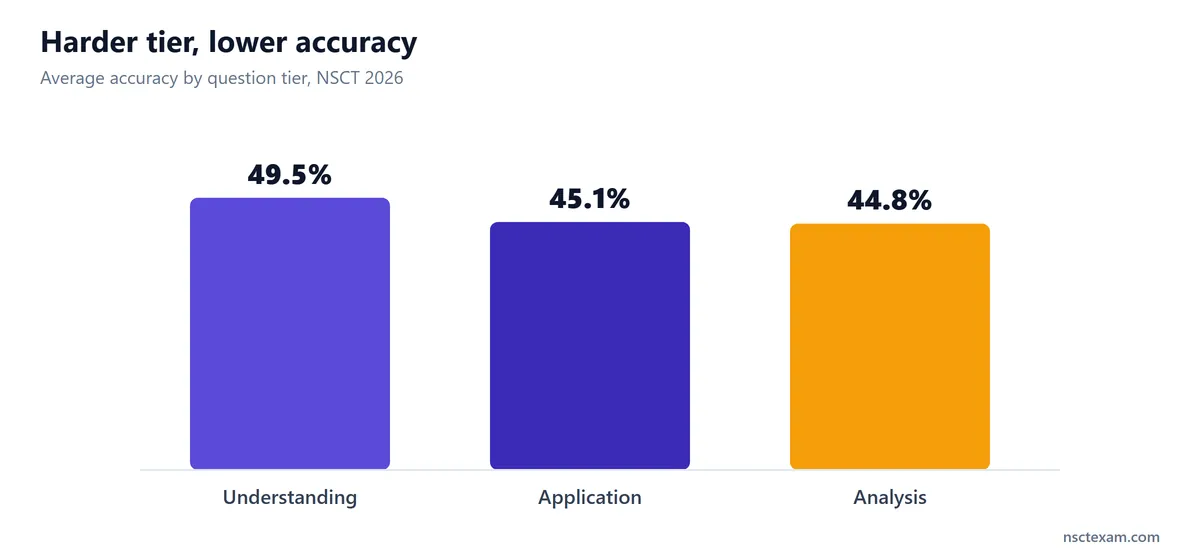
Source: HEC NSCT report. What this means for you:
- Tier 1 is not "free marks". Half the country missed recall questions. Fixing definitions across all ten areas is the cheapest gain available.
- Tiers 2 and 3 reward practice, not reading. Spend most of your study time solving, tracing and debugging.
- Weak subjects hurt in every tier. Operating Systems had the lowest 2026 subject accuracy at 33.8% (APP, 17 June 2026). See NSCT 2026 Subject-Wise Results.
What is not officially confirmed
- How many questions sit in each tier. HEC reports accuracy per tier, not the share of questions per tier.
- Total number of questions and negative marking. HEC has not officially announced either yet. Check nsct.hec.gov.pk and your university's focal person.
- Official sample questions. HEC has not officially released past papers or sample questions. Every example on this site is our own.
FAQs
What types of questions come in the NSCT?
HEC's report groups NSCT questions into three cognitive tiers: Understanding (recall, syntax and definitions), Application (applying known rules to constrained problems) and Analysis (architecture, debugging and multi-step logic). They are spread across 10 competency areas, with Problem Solving carrying the most weight at 20%.
Which NSCT question tier is hardest?
By 2026 results, Analysis was hardest, at 44.8% accuracy, just below Application at 45.1%. Understanding was highest at 49.5%. The small gap between the top two tiers matters more than the ranking: HEC suggests students began guessing once questions left familiar textbook patterns.
What share of the NSCT is analysis questions?
HEC has not published how many questions fall into each tier. Its report gives only the accuracy for each one. Prepare for all three, and spend more practice time on application and analysis, because those need worked problems rather than memorised facts.
Are the example questions on this page from the real NSCT?
No. HEC has not officially released NSCT papers or sample questions. We wrote these examples to match HEC's published description of each tier. They show the kind of thinking each tier needs, not the exact wording of real test items.
How do I get better at analysis questions?
Trace code by hand, debug small programs, and practise explaining why each wrong option fails. Mix subjects in a session so you have to choose the method yourself. Timed mock tests help too, because analysis questions are where the clock usually runs out.
Next step
Put the three tiers into practice: try NSCT MCQs by subject, then a timed NSCT mock test. For tactics on tricky options, read NSCT MCQ Strategy.