NSCT MCQs: Free Practice for All 10 Competency Areas
This is a free bank of NSCT practice MCQs, each with an answer and a short explanation, organised under the 10 official Areas of Competencies and their topics. Pick an area below, start with the one that carries the most weight or the one where 2026 candidates struggled most, and practise topic by topic.
Every question here is written by our team. None of them are taken from the real test: HEC has not published official past papers, and we do not claim to have any.
The 10 areas at a glance
The weightage comes from HEC's Areas of Competencies. The 2026 average is the national accuracy per area from the HEC NSCT report, also reported by APP.
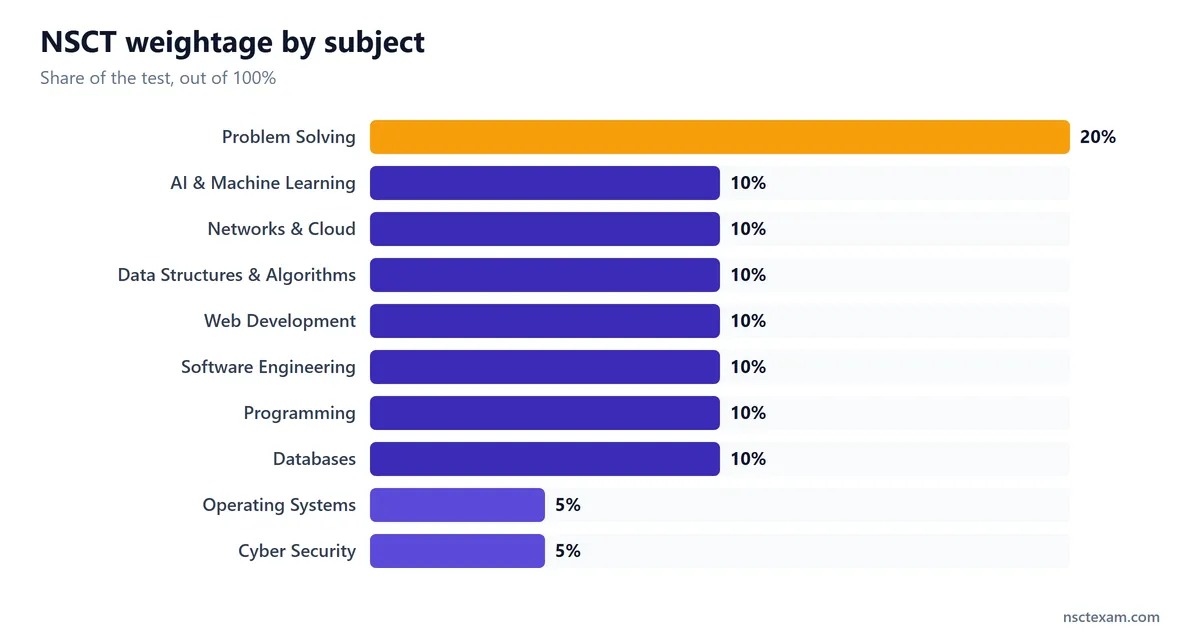
| Competency area | Weightage | 2026 average accuracy | Practise |
|---|---|---|---|
| Problem Solving and Analytical Skills | 20% | 49.1% | Problem Solving MCQs |
| AI / Machine Learning and Data Analytics | 10% | 50.8% | AI & ML MCQs |
| Computer Networks and Cloud Computing | 10% | 39.6% | Networks & Cloud MCQs |
| Data Structures & Algorithms | 10% | 40.2% | DSA MCQs |
| Web Development | 10% | 54.1% | Web Development MCQs |
| Software Engineering | 10% | 50.1% | Software Engineering MCQs |
| Programming (C++/Java/Python) | 10% | 47.8% | Programming MCQs |
| Databases | 10% | 42.3% | Database MCQs |
| Operating Systems | 5% | 33.8% | Operating Systems MCQs |
| Cyber Security | 5% | 47.2% | Cyber Security MCQs |
Two patterns stand out. Problem Solving alone carries 20%, twice any other area. And the "deep tech" areas were the weakest in 2026: Operating Systems (33.8%), Networks (39.6%), DSA (40.2%) and Databases (42.3%). Those four are where steady practice moves your score most.
Ways to practise
- By area and topic: open an area above, then a topic. Each topic page has a short explainer and its own question set.
- By question tier: HEC's report groups questions into Understanding, Application and Analysis. Practise each tier on its own.
- By difficulty: warm up on easy sets, then move to hard ones.
- Code tracing: read a snippet and predict the output, the way you would in a debugging question.
- Numericals: CPU scheduling, subnetting, page replacement, Big-O and similar calculations.
- Review your mistakes: go back to the questions you got wrong.
- Daily quiz: a short mixed set each day to keep recall fresh.
- Full mock tests: timed, mixed-area practice once you have covered the topics.
If you prefer offline study, the NSCT MCQs PDF page collects downloadable sets. The sample paper shows a full mixed set in one place.
How our questions are written
Each MCQ is original and mapped to one official topic from HEC's competency list, so you always know which part of the syllabus it trains. We tag it with a tier (Understanding, Application or Analysis) and a difficulty level, then a second reviewer checks the answer and the explanation against standard textbooks. Where two well-known textbooks differ, the explanation says so.
What we do not do: copy questions from the real test, or claim our questions will appear in it. HEC has not officially announced the number of questions in the real test or any marking scheme beyond the score out of 100. Check nsct.hec.gov.pk and your university's focal person for format updates, and see the NSCT test pattern for what is confirmed.
If a word in a question is unfamiliar, check the NSCT glossary before moving on.
FAQs
Are these the real NSCT MCQs?
No. Every question on this site is written by our team and mapped to an official HEC topic. HEC has not released the 2026 paper or any official past papers, so any site that claims to have the real questions should be treated with caution. What we offer is practice that covers the same official topics and the same three cognitive tiers HEC describes in its report.
Which NSCT subject should I practise first?
Start with Problem Solving and Analytical Skills, because it carries 20% of the test, twice any other area. After that, give extra time to the areas where 2026 candidates scored lowest: Operating Systems (33.8%), Networks and Cloud (39.6%), DSA (40.2%) and Databases (42.3%). A quick diagnostic set in each area will show you your own weak spots.
Are the NSCT practice MCQs free?
Yes. Every question, explanation, daily quiz and mock test on nsctexam.com is free to use. The NSCT itself is also free for eligible students according to HEC. You do not need an account to practise, though saving your progress helps you track weak topics and return to the questions you got wrong.
How many MCQs should I practise before the NSCT?
There is no official number, and HEC has not announced how many questions the real test has. As a rule of thumb, keep practising a topic until you score well on a fresh set without looking at the notes. Spread your practice roughly in line with the official weightage, then finish with full timed mock tests.
Next step
Pick your first area from the table above, or test yourself across all ten in a timed NSCT mock test.