NSCT 2026 Results: The Key Numbers and What They Mean for You
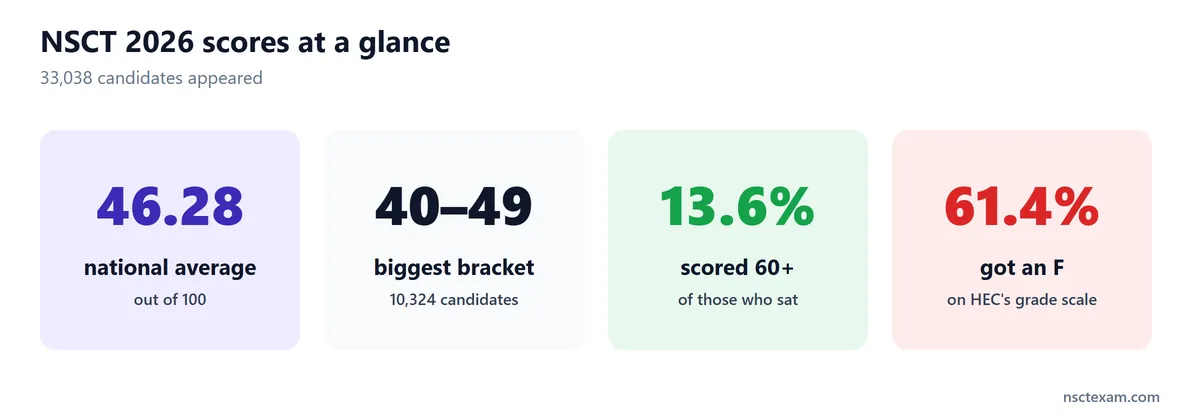
HEC announced the NSCT 2026 results on 17 June 2026, APP reported, and published them on its NSCT Result page. According to HEC's 2026 report, 33,038 candidates sat the test and the national average was 46.28 out of 100.
Those two numbers frame everything else. Most candidates scored in the 30s, 40s and 50s, and very few broke 60. Below are the figures that matter most if you are preparing now, with what each one tells you.
From registration to results
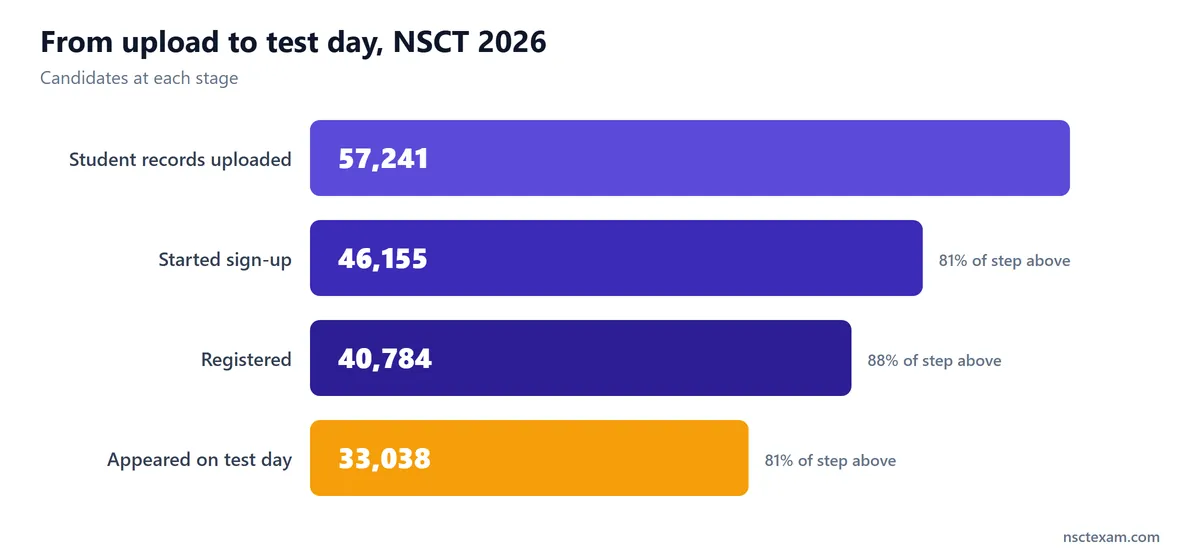
The report traces every candidate from the first data upload to the exam hall.
| Stage | Candidates |
|---|---|
| Records uploaded by universities | 57,241 |
| Started sign-up on the portal | 46,155 |
| Registered (profile verified) | 40,784 |
| Appeared and were analysed | 33,038 |
APP reported 188 universities registered, citing HEC; APP's report on the test gave 199 universities. The test ran on 4–5 April 2026 in four 120-minute sessions a day across 165 centres in 112 cities.
What it means for you: about 7,700 registered students did not appear (our calculation from the table). Registration is not the finish line. Appearance is mandatory, so plan your test day early.
The national average: 46.28
The national average was 46.28 out of 100. The report describes the distribution as "a classic bell curve that is heavily skewed toward the 30–59 range".
The report also compares 2026 with the 2024 HEC Centralized Test for IT Graduates, the NSCT's predecessor. That test had 9,253 candidates and an average around 46, almost identical despite 2026 having far more candidates. See NSCT 2026 vs HEC's 2024 Centralized Test for I….
What it means for you: a score near 46 is ordinary. Anything you add above that moves you ahead of most of the country.
Score distribution
| Measure (2026) | Figure |
|---|---|
| Largest bracket | 40–49, with 10,324 candidates |
| Scored 60 or more | 13.6% (13.9% in 2024) |
| F bracket on HEC's grade scale | 61.4% (over 20,000 students) |
| D and F brackets combined | nearly 83% |
Official source
"Both datasets display a sharp drop-off after 60 marks, with only ~13.9% of students crossing that threshold in 2024 compared to 13.6% in 2026." (HEC, NSCT 2026 Overview Report)
What it means for you: 60 is the line where the crowd thins out. HEC has not published a passing mark, but reaching 60 puts you in roughly the top 13.6%. More on NSCT Passing Marks.
Weak subjects
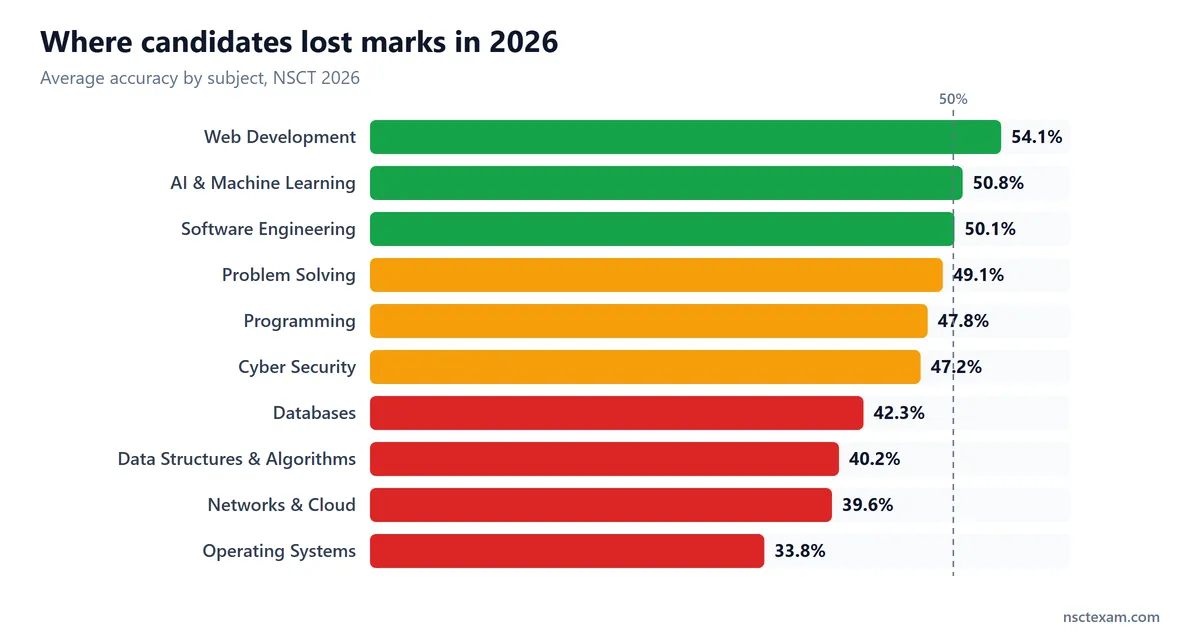
HEC reported average accuracy for each competency area. Web Development led at 54.1%, followed by AI/ML 50.8%, Software Engineering 50.1%, Problem Solving 49.1% and Programming 47.8%. The weakest were Cyber Security 47.2%, Databases 42.3%, DSA 40.2%, Networks 39.6% and Operating Systems 33.8%.
The report also split accuracy by question type: Understanding (recall and definitions) 49.5%, Application (using a known rule) 45.1%, and Analysis (multi-step logic and debugging) 44.8%. It suggests students "start guessing when forced outside of rehearsed textbook scenarios".
What it means for you: revise the "deep tech" areas (OS, Networks, DSA, Databases), and practise applying concepts, not just memorising them. Full analysis: NSCT 2026 Subject-Wise Results.
Results by region
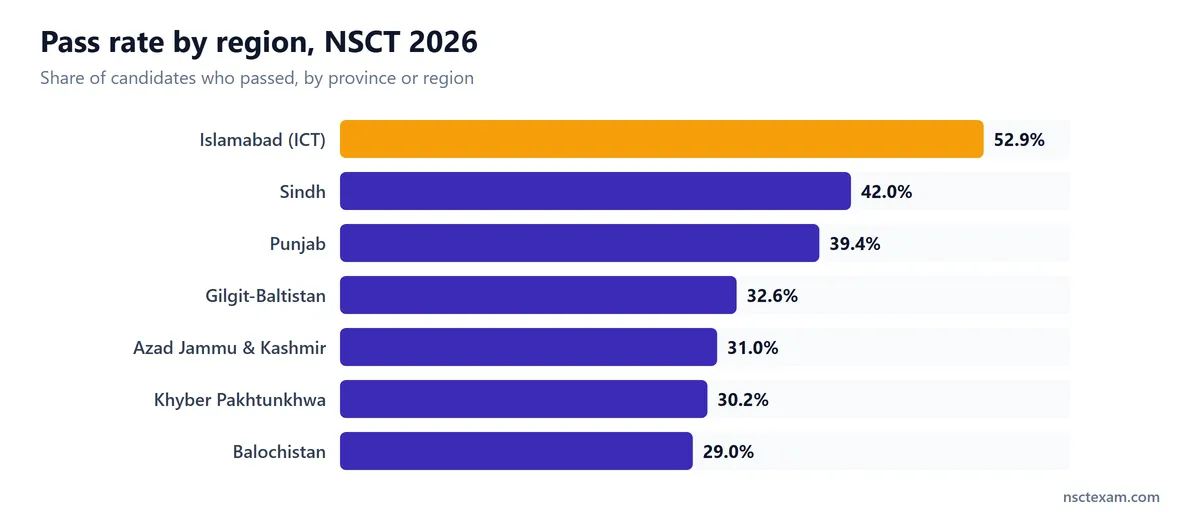
According to APP, pass rates were: ICT 52.9%, Sindh 42.0%, Punjab 39.4%, Gilgit-Baltistan 32.6%, AJK 31.0%, Khyber Pakhtunkhwa 30.2% and Balochistan 29.0%. The report adds that urban candidates passed at 40.5% (female) to 44.5% (male), while rural pass rates hovered around 26–28%. Details: NSCT 2026 Results by Province, Urban vs Rural ….
Results by gender
Male candidates outnumbered female candidates 21,047 to 11,990, but the report says the pass rate difference between them was just 2.5%. Its conclusion is that the challenge "lies purely in access, outreach, and increasing female enrollment", not ability.
Top universities and students
Habib University had the highest pass rate at 96.5%, followed by the Information Technology University of the Punjab (90.4%), FAST-NUCES (89.5%) and NUST (89.2%). Virtual University had the most candidates (3,135) and 7 of the top 30 students nationally. See NSCT 2026 Top Universities.
What is not officially confirmed
HEC has not published a passing mark, the score boundaries of its grade mapping, or the qualifying score for benefits. HEC has not officially announced the next test dates either; check nsct.hec.gov.pk and your university's focal person, and see NSCT 2027.
If you sat the test, here is how to check your own NSCT result and read the subject breakdown.
FAQs
When was the NSCT 2026 result announced?
APP reported on 17 June 2026 that HEC had announced the results of the first NSCT. The test had been held on 4–5 April 2026. HEC published the university-wise results, top students and the full report on its NSCT Result page.
What was the NSCT 2026 national average?
The national average was 46.28 out of 100, across 33,038 candidates who appeared, according to HEC's 2026 overview report. The largest group, 10,324 candidates, scored between 40 and 49.
How many students passed the NSCT 2026?
HEC did not publish a single national pass figure in the report text. On its grade-scale mapping, 61.4% of candidates were in the F bracket. Pass rates by region ranged from 52.9% in ICT to 29.0% in Balochistan.
Which subject was hardest in NSCT 2026?
Operating Systems had the lowest average accuracy at 33.8%, followed by Networks and Cloud at 39.6% and DSA at 40.2%. Web Development had the highest at 54.1%, according to HEC's figures reported by APP.
How many students appeared in NSCT 2026?
HEC's report says 33,038 candidates appeared, out of 40,784 who registered and 57,241 records uploaded by universities. HEC's results page describes the total as 33,000+ students tested across 165 centres in 112 cities.
Next step
Use the 2026 numbers as your benchmark: aim for 60 or more. Start with a timed NSCT mock test to see where you stand, then target the weak areas with subject-wise MCQs.