NSCT 2026 Subject-Wise Results: All 10 Areas Ranked
In the NSCT 2026 results, Web Development had the highest average accuracy at 54.1% and Operating Systems the lowest at 33.8%, according to HEC figures reported by APP on 17 June 2026 and shown in HEC's 2026 report. Not one of the 10 competency areas reached a national average of 55%.
"Accuracy" here means the share of questions in that area that candidates answered correctly, averaged across the 33,038 people who sat the test. Read alongside the official syllabus weightage, it tells you where the easiest marks are for you to gain.
All 10 subjects ranked
| Rank | Competency area | 2026 average accuracy | Weightage |
|---|---|---|---|
| 1 | Web Development | 54.1% | 10% |
| 2 | AI / Machine Learning and Data Analytics | 50.8% | 10% |
| 3 | Software Engineering | 50.1% | 10% |
| 4 | Problem Solving And Analytical Skills | 49.1% | 20% |
| 5 | Programming (C++/Java/Python) | 47.8% | 10% |
| 6 | Cyber Security | 47.2% | 5% |
| 7 | Databases | 42.3% | 10% |
| 8 | Data Structures & Algorithms | 40.2% | 10% |
| 9 | Computer Networks and Cloud Computing | 39.6% | 10% |
| 10 | Operating Systems | 33.8% | 5% |
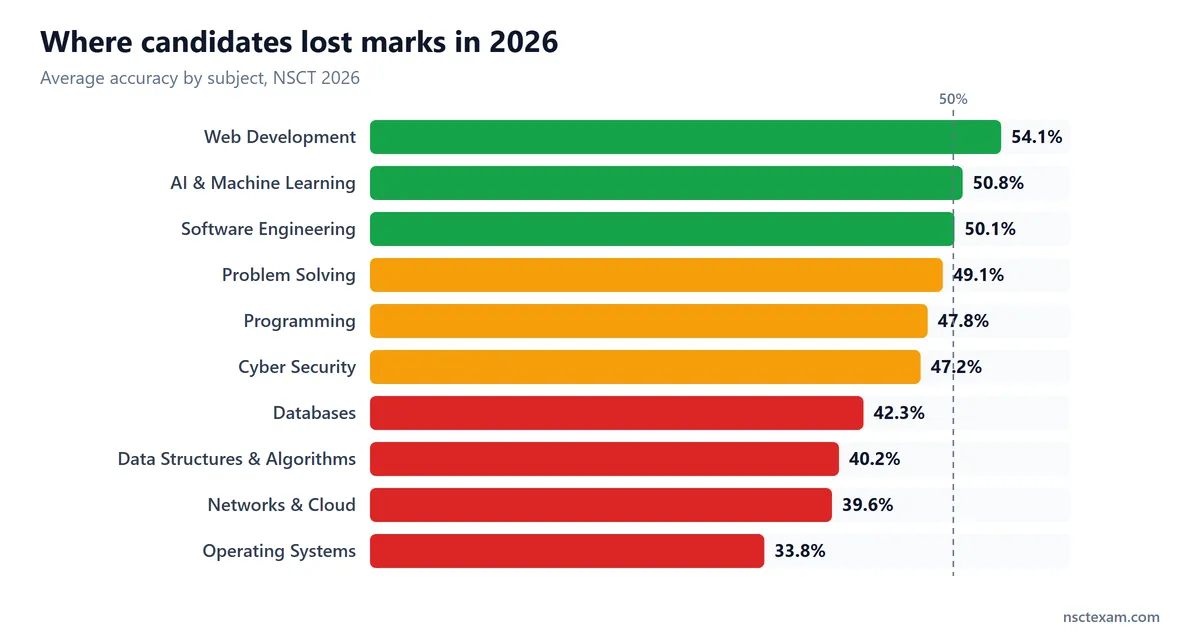
Accuracy figures: HEC report and APP. Weightage: the Areas of Competencies page on the NSCT portal.
Official source
"The data immediately highlights a massive divide: students perform relatively well in 'Applied' subjects like Web Development (54.1% avg) but fail catastrophically in 'Deep Tech' like Operating Systems (33.8% avg)." (HEC, NSCT 2026 Overview Report)
The stronger half: applied subjects
Web Development (54.1%), AI/ML (50.8%) and Software Engineering (50.1%) were the only areas above 50%. These are subjects many students meet outside class through freelancing, tutorials and FYPs, which likely helps. APP's headline called it the "highest number of proficiency in web development".
Even so, 54.1% is barely over half. Being "relatively good" nationally still leaves plenty of marks on the table.
Problem Solving (49.1%) deserves special attention. It carries 20% of the test, double any other area, and the average was below 50%. Improving here moves your total more than improving anywhere else.
The weaker half: deep-tech subjects
Operating Systems (33.8%) was the weakest area by a clear margin. Networks (39.6%), DSA (40.2%) and Databases (42.3%) were next. These are the theory-heavy core courses: scheduling, deadlocks, the OSI layers, complexity analysis, normalisation and transactions.
APP's report also named Cyber Security (47.2%) as an area "requiring the greatest improvement", alongside the four above, even though its average was higher than theirs.
Why the gap? The tier breakdown
HEC's report also measured accuracy by cognitive tier:
| Tier | What it tested | 2026 accuracy |
|---|---|---|
| Understanding | Recall, syntax, foundational definitions | 49.5% |
| Application | Applying known rules to constrained problems | 45.1% |
| Analysis | Complex architecture, debugging, multi-step logic | 44.8% |
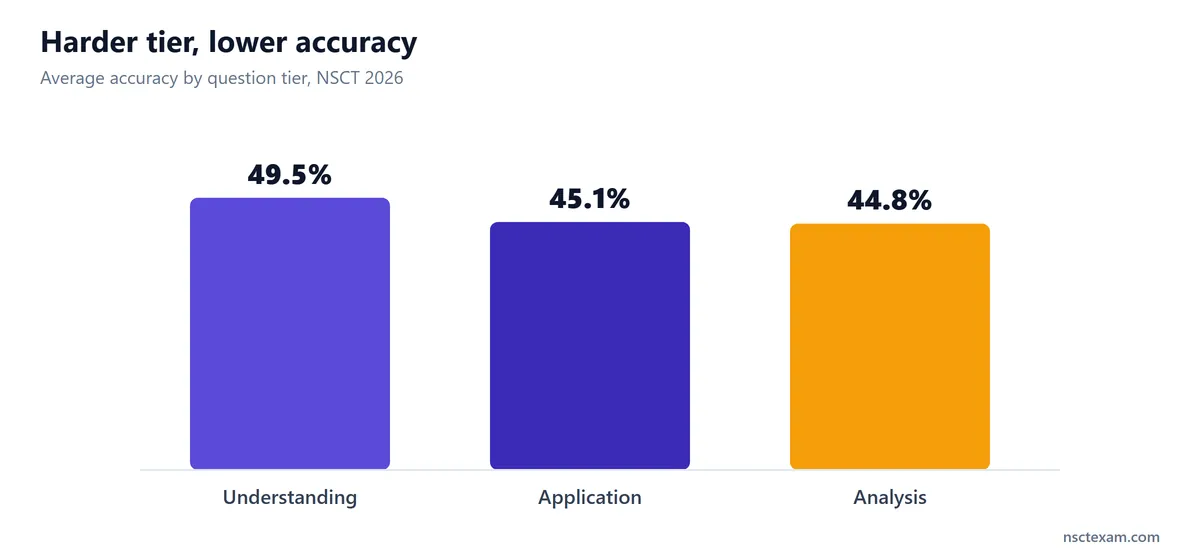
The report notes that the flat line between Application and Analysis "suggests students start guessing when forced outside of rehearsed textbook scenarios". Deep-tech subjects lean heavily on application: tracing a scheduling algorithm or working out a Big-O bound is not something you can recall. Practise by tier with NSCT Practice by Question Tier.
What this means for your preparation
Combine the accuracy figures with the weightage and a clear order appears:
- Problem Solving (20%, 49.1%). The biggest single block of marks, and the average was under half. Start with problem solving MCQs.
- DSA, Networks and Databases (10% each, 39.6–42.3%). Big gaps in areas that carry full weight. Practise DSA, networks and databases.
- Operating Systems (5%, 33.8%). Small weight, but the lowest average, so even basic revision with OS MCQs lifts you above most candidates.
- Keep your strong areas warm. Web, AI/ML and SE still averaged only about 50–54%, so there is room there too.
For how other parts of the country and individual universities performed, see results by province and top universities.
What is not officially confirmed
HEC has published national averages per area. It has not published how many questions each area contributed, the difficulty of individual questions, or subject averages by university. HEC has also not officially announced the next test dates; check nsct.hec.gov.pk and your university's focal person.
FAQs
Which subject had the highest score in NSCT 2026?
Web Development had the highest average accuracy at 54.1%, according to HEC's figures reported by APP. It was followed by AI/ML at 50.8% and Software Engineering at 50.1%. These were the only three areas with averages above 50%.
Which subject was the hardest in NSCT 2026?
Operating Systems was the hardest, with an average accuracy of only 33.8%. Networks and Cloud (39.6%), DSA (40.2%) and Databases (42.3%) were the next weakest. HEC's report describes students as failing "catastrophically" in these deep-tech subjects.
Should I skip Operating Systems because it is only 5%?
No. It carries 5% of the test, but the national average was just 33.8%, so modest revision puts you ahead of most candidates. Focus on high-yield topics from the official list, such as CPU scheduling, deadlocks and memory management.
What does "accuracy" mean in the NSCT subject results?
It is the average percentage of questions in that competency area that candidates answered correctly in 2026. For example, 40.2% in DSA means that, on average, candidates got about four in ten DSA questions right.
How should I use subject-wise results to prepare for NSCT?
Multiply weight by weakness. Problem Solving is 20% with a 49.1% average, so it comes first. DSA, Networks and Databases are 10% each with averages around 40%, so they come next. Then take diagnostic MCQs to see whether your own weak spots match the national pattern.
Next step
Find your own subject-wise gaps with a timed NSCT mock test, then start drilling your lowest area with the practice links in the preparation order above.