NSCT Syllabus: 10 Competency Areas and Every Official Topic
The NSCT syllabus is HEC's official list of 10 "Areas of Competencies", each with a fixed weightage and a numbered list of topics, published on the NSCT portal. Problem Solving and Analytical Skills carries 20%, Operating Systems and Cyber Security carry 5% each, and the other seven areas carry 10% each, for 149 topics in total.
That list is the whole syllabus. There is no separate textbook or "HEC book". If a topic is on the list below, it can be tested; if it is not, you can safely give it less time.
Where the syllabus comes from
According to Virtual University's notice, the competency areas were finalised by a Technical Committee led by P@SHA, the Pakistan Software Houses Association, with members from industry, academia and accreditation bodies.
Official source
"The test will be based on industry-endorsed competency areas, finalized through a dedicated Technical Committee led by P@SHA, with representation from industry, academia, accreditation bodies, and other relevant stakeholders." (Virtual University of Pakistan, 10 March 2026)
The same notice advised all eligible students to "start preparing for the test in accordance with the competency areas". In other words, the areas below are the brief you are being tested against, not a rough guide.
The 10 areas at a glance
Weightage is the share of the test each area represents. The topic counts are taken from the official list on the Areas of Competencies page.
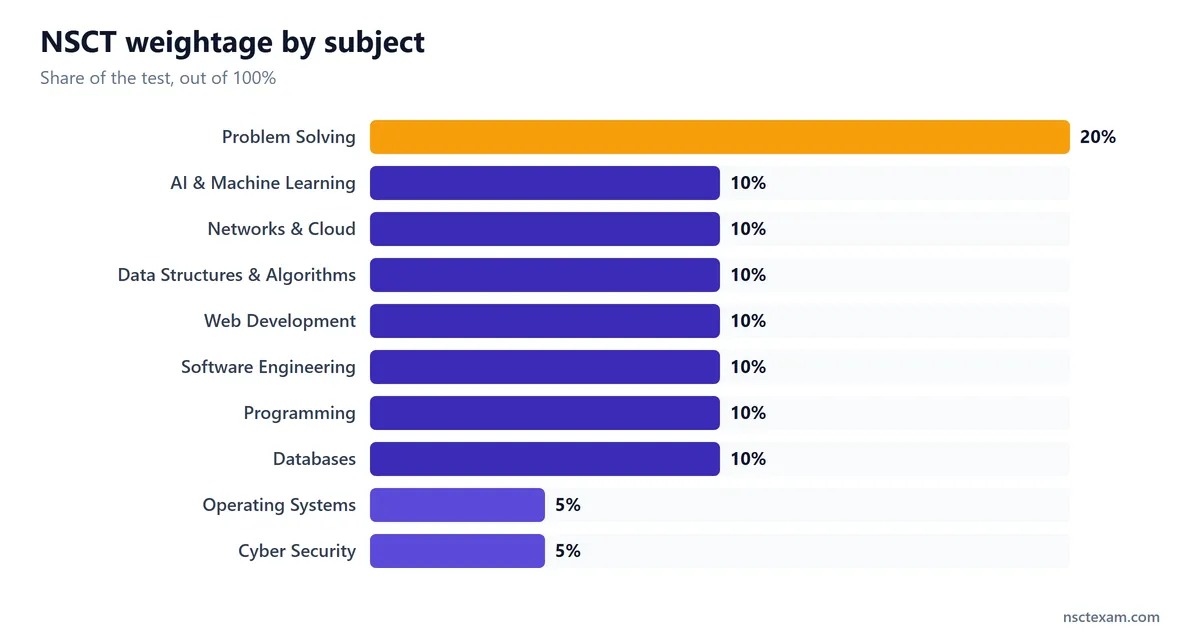
| # | Competency area (official name) | Weightage | Topics | Practice hub |
|---|---|---|---|---|
| 1 | Problem Solving And Analytical Skills | 20% | 16 | NSCT Problem Solving and Analytical Skills MCQs |
| 2 | AI / Machine Learning and Data Analytics | 10% | 17 | NSCT AI, Machine Learning and Data Analytics M… |
| 3 | Computer Networks and Cloud Computing | 10% | 10 | NSCT Computer Networks and Cloud Computing MCQs |
| 4 | Data Structures & Algorithms | 10% | 12 | NSCT Data Structures and Algorithms MCQs |
| 5 | Web Development | 10% | 17 | NSCT Web Development MCQs |
| 6 | Software Engineering | 10% | 16 | NSCT Software Engineering MCQs |
| 7 | Programming (C++/Java/Python) | 10% | 16 | NSCT Programming (C++/Java/Python) MCQs |
| 8 | Databases | 10% | 17 | NSCT Databases MCQs |
| 9 | Operating Systems | 5% | 12 | NSCT Operating Systems MCQs |
| 10 | Cyber Security | 5% | 16 | NSCT Cyber Security MCQs |
For how to turn these percentages into study hours, see NSCT weightage explained.
Every official topic, area by area
Topic names are copied exactly as HEC lists them, including American spellings such as "Normalization".
Problem Solving And Analytical Skills (20%)
Introduction to Problem Solving · Problem Understanding & Analysis · Logical Reasoning Fundamentals · Algorithms & Flow Control · Data Representation & Abstraction · Pattern Recognition & Generalization · Mathematical & Quantitative Reasoning · Algorithmic Thinking · Critical Thinking & Decision Making · Debugging & Error Analysis · Complexity & Efficiency Awareness · Problem Solving Using Programming · Data-Driven Problem Solving · Creative & Innovative Thinking · Real-World Problem Solving · Communication & Documentation of Solutions. Practise: problem solving MCQs
AI / Machine Learning and Data Analytics (10%)
Introduction to AI, ML & Data Analytics · Mathematical Foundations · Python for AI & Data Analytics · Data Collection & Pre-processing · Exploratory Data Analysis (EDA) · Supervised Learning · Ensemble Learning · Unsupervised Learning · Model Evaluation & Validation · Feature Engineering & Selection · Deep Learning Fundamentals · Advanced Deep Learning · Natural Language Processing (NLP) · Computer Vision · Big Data Analytics (Introductory) · Model Deployment & MLOps Basics · AI Ethics, Security & Privacy. Practise: AI/ML MCQs
Computer Networks and Cloud Computing (10%)
Data Communication · Computer Networks · Data Link Layer · Network Layer · Transport Layer · Application Layer · Wireless Networks · Cloud Computing · Network Security (Networks Perspective) · Next Generation Networks. Practise: networks and cloud MCQs
Data Structures & Algorithms (10%)
Foundations of Data Structure and Algorithms · Linear Data Structures · Non-Linear Data Structures · Searching Algorithms · Sorting Algorithms · Hashing · Tree Algorithms · Graph Algorithms · Algorithm Design Techniques · Advanced Data Structures · String Algorithms · Complexity & Optimization. Practise: DSA MCQs
Web Development (10%)
Introduction to Web Development · Web Architecture & Protocols · HTML Fundamentals · CSS Fundamentals · Advanced CSS & Responsive Design · JavaScript Fundamentals · Advanced JavaScript · Frontend Frameworks & Libraries · Backend Development Fundamentals · Server-Side Programming · Databases for Web Applications · Web Security · Web Performance & Optimization · Web Testing & Debugging · Deployment & Hosting · Web APIs & Integration · Modern Web Development Practices. Practise: web development MCQs
Software Engineering (10%)
Introduction to Software Engineering · Software Process Models · Agile Software Development · Software Requirements Engineering · Software Project Management · Software Design · Software Architecture · User Interface Design · Software Implementation & Coding · Software Testing · Software Maintenance & Evolution · Software Quality Assurance · Software Metrics & Measurement · Software Configuration Management · Software Risk Management · Software Security Engineering. Practise: software engineering MCQs
Programming (C++/Java/Python) (10%)
Programming Fundamentals · Data Types & Variables · Operators & Expressions · Control Structures · Functions / Methods · Input / Output Handling · Strings & Text Processing · Arrays & Collections · Object-Oriented Programming (OOP) · Memory Management Concepts · Exception & Error Handling · Modules, Packages & Libraries · Advanced Programming Concepts · Concurrency & Parallelism (Introductory) · Debugging, Testing & Optimization · Software Development Practices. Practise: programming MCQs
Databases (10%)
Introduction to Database Systems · Database System Architecture · Data Models · Relational Database Concepts · Relational Algebra & Calculus · Structured Query Language (SQL) · Advanced SQL · Database Design & Normalization · Transaction Management · Concurrency Control · Recovery Management · Indexing & File Organization · Query Processing & Optimization · Database Security · Distributed Databases · NoSQL & Modern Databases · Data Warehousing & Data Mining (Introductory). Practise: database MCQs
Operating Systems (5%)
Introduction to Operating Systems · Operating System Structures · Process Management · CPU Scheduling · Thread Management · Concurrency & Synchronization · Deadlocks · Memory Management · File System Management · Secondary Storage Management · Input / Output Systems · Protection & Security. Practise: operating systems MCQs
Cyber Security (5%)
Introduction to Cyber Security · Security Fundamentals & Principles · Cryptography Basics · Network Security · Operating System Security · Web Application Security · Malware & Attack Techniques · Authentication & Access Control · Secure Software Development · Wireless & Mobile Security · Cloud & Virtualization Security · Digital Forensics · Incident Response & Management · Security Monitoring & Auditing · Cyber Laws & Ethics · Emerging Trends in Cyber Security. Practise: cyber security MCQs
How to use the syllabus with the 2026 results
Weightage tells you where the marks are. The 2026 results tell you where students lost them. HEC's 2026 report and APP's coverage of the results give these average accuracy figures by area: Web Development 54.1%, AI/ML 50.8%, Software Engineering 50.1%, Problem Solving 49.1%, Programming 47.8%, Cyber Security 47.2%, Databases 42.3%, DSA 40.2%, Networks 39.6% and Operating Systems 33.8%.
Put the two together and three priorities stand out:
- Problem Solving first. At 20%, it is worth twice any other area, and the 2026 average there was only 49.1%.
- DSA, Networks and Databases next. Each is 10%, and each averaged between 39.6% and 42.3%, so there is a lot of room to gain.
- Do not skip Operating Systems. It is only 5%, but at 33.8% it was the weakest area nationally. A little revision of scheduling, deadlocks and memory management goes a long way.
The full breakdown is on NSCT 2026 subject-wise scores.
What is not officially confirmed
HEC has published the areas, weightage and topic names. It has not published a per-topic weightage, a reading list, or a separate syllabus for the next sitting. HEC has not officially announced the 2027 test dates either, so check nsct.hec.gov.pk and your university's focal person, and read our NSCT 2027 page for updates. For the format of the test itself, see NSCT Test Pattern Explained.
FAQs
What is the NSCT test syllabus?
The NSCT syllabus is HEC's list of 10 competency areas: Problem Solving, AI/ML, Networks and Cloud, DSA, Web Development, Software Engineering, Programming, Databases, Operating Systems and Cyber Security. Each area has a numbered topic list, 149 topics in all, on the official Areas of Competencies page of the NSCT portal.
Is the NSCT syllabus 2026 the same for the next test?
The 2026 list is the latest syllabus HEC has published. HEC has not announced a revised version, so it is the safest basis for preparation now. If a new list appears on nsct.hec.gov.pk, the weightage table above will change with it, so recheck before your final month of revision.
Which NSCT subject has the highest weightage?
Problem Solving And Analytical Skills has the highest weightage at 20%. Seven areas carry 10% each, and Operating Systems and Cyber Security carry 5% each. Problem solving covers logic, quantitative reasoning, algorithmic thinking and debugging, so it overlaps with your programming and DSA revision.
Where can I download the NSCT syllabus from HEC?
The official list is on the NSCT portal's Areas of Competencies page, and Virtual University's notices linked a PDF version on the same portal. We reproduce every topic name above so you can read it on your phone even when the portal is slow.
Does the NSCT syllabus include programming in a specific language?
The official area is titled "Programming (C++/Java/Python)". HEC lists the three languages in the title but does not say how questions are split between them. Focus on concepts that apply to all three, such as control structures, OOP and exception handling, and be fluent in at least one.
Next step
Pick the area with the biggest gap between its weightage and your confidence, and start there with free NSCT MCQs by subject. When you have covered all 10 areas, test yourself under time pressure with a full NSCT mock test.