NSCT Syllabus Weightage by Subject
The NSCT syllabus has 10 competency areas. Problem Solving and Analytical Skills carries 20%, Operating Systems and Cyber Security carry 5% each, and the other seven areas carry 10% each, according to HEC's official Areas of Competencies. The weights add up to 100%, and NSCT scores are reported out of 100 (HEC report).
Below are the official weights, how many topics each area lists, how students actually performed in each area in 2026, and a study-hours plan built from those numbers.
Official NSCT weightage table
| Competency area (HEC's name) | Weightage | Topics listed |
|---|---|---|
| Problem Solving And Analytical Skills | 20% | 16 |
| Computer Networks and Cloud Computing | 10% | 10 |
| Programming (C++/Java/Python) | 10% | 16 |
| Data Structures & Algorithms | 10% | 12 |
| Software Engineering | 10% | 16 |
| Web Development | 10% | 17 |
| AI / Machine Learning and Data Analytics | 10% | 17 |
| Databases | 10% | 17 |
| Operating Systems | 5% | 12 |
| Cyber Security | 5% | 16 |
| Total | 100% | 149 |
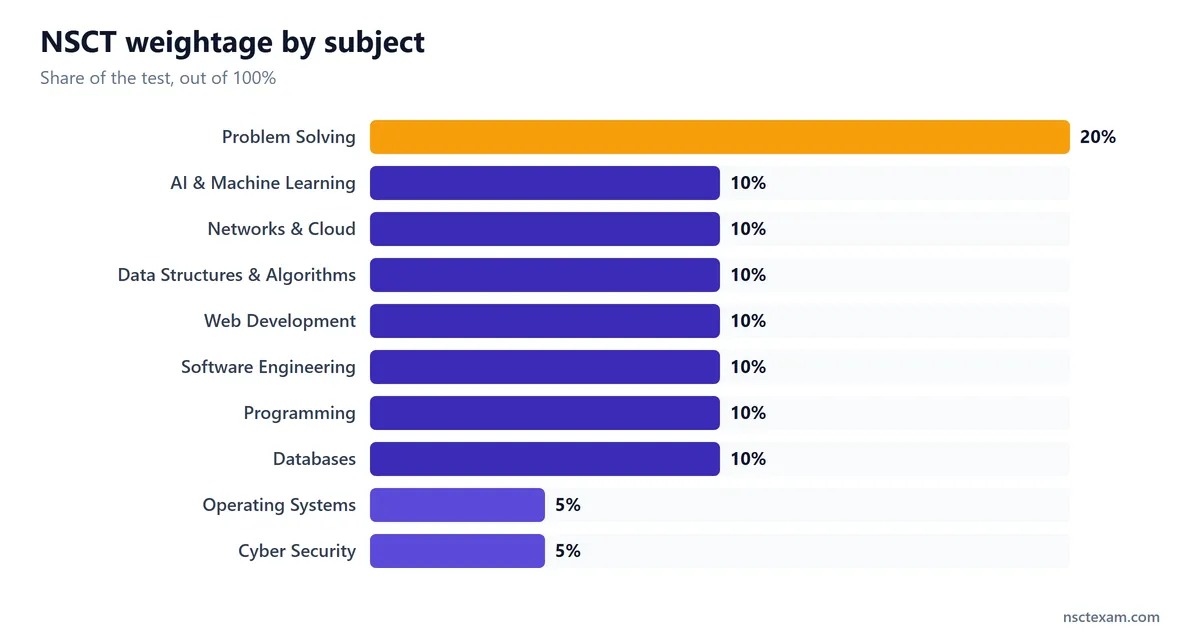
Source: Areas of Competencies for National Skill Competency Test. A Technical Committee led by P@SHA, with members from industry, academia and accreditation bodies, finalised these areas (NSCT portal).
Official source
"The test shall be based on industry-endorsed competency areas, finalised through a dedicated Technical Committee led by P@SHA." (NSCT portal)
The full topic list for each area is on our NSCT syllabus page.
What the weights tell you
Problem Solving is the single biggest block. At 20%, it is worth as much as two ordinary areas. Its topics, such as logical reasoning, pattern recognition, quantitative reasoning, algorithmic thinking and debugging, also overlap with Programming and DSA, so time spent here pays off twice.
Weight per topic varies widely. Weightage divided by the number of listed topics gives a rough "marks per topic" figure. HEC does not say questions are spread evenly across topics, so treat this as a guide only:
| Area | Weight ÷ topics |
|---|---|
| Problem Solving | about 1.25% per topic |
| Networks & Cloud | 1.00% per topic |
| DSA | about 0.83% per topic |
| Programming, Software Engineering | about 0.63% per topic |
| Web, AI/ML, Databases | about 0.59% per topic |
| Operating Systems | about 0.42% per topic |
| Cyber Security | about 0.31% per topic |
Networks has only 10 topics for its 10%, so each topic carries more. Cyber Security spreads 5% over 16 topics, so chasing every detail there gives the lowest return.
How students scored in each area (2026)
| Area | 2026 accuracy | Weightage |
|---|---|---|
| Web Development | 54.1% | 10% |
| AI / Machine Learning | 50.8% | 10% |
| Software Engineering | 50.1% | 10% |
| Problem Solving and Analytics | 49.1% | 20% |
| Programming | 47.8% | 10% |
| Cyber Security | 47.2% | 5% |
| Databases | 42.3% | 10% |
| Data Structures & Algorithms | 40.2% | 10% |
| Networks & Cloud | 39.6% | 10% |
| Operating Systems | 33.8% | 5% |
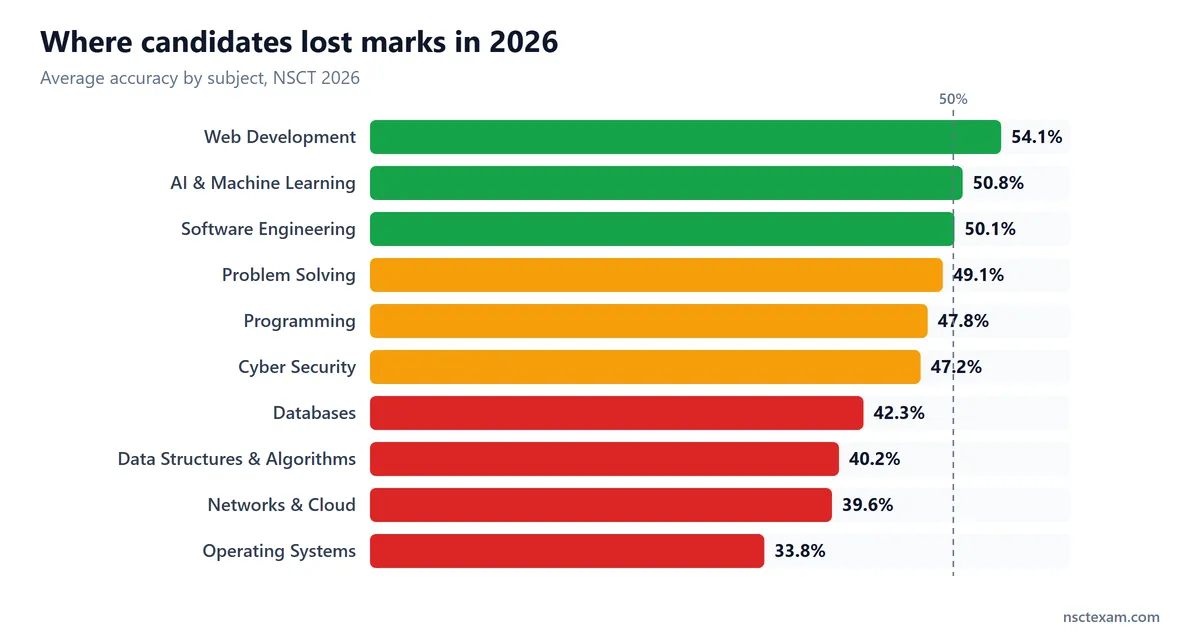
Accuracy source: APP, 17 June 2026 and the HEC NSCT report. More detail is on NSCT 2026 Subject-Wise Results.
Put the two tables together and three areas stand out: DSA, Networks and Databases each carry 10% and each sat in the low 40s or below. Problem Solving at 49.1% leaves the most room to gain simply because it is worth 20%.
Turning weightage into study hours
Here is a sample split for 100 study hours. It starts from the official weights, then shifts a few hours towards the areas where 2026 candidates did worst. This is our recommendation, not an HEC rule.
| Area | Hours | Reasoning |
|---|---|---|
| Problem Solving | 20 | 20% weight; overlaps with Programming and DSA |
| Data Structures & Algorithms | 12 | 10% weight, 40.2% accuracy in 2026 |
| Networks & Cloud | 12 | 10% weight, 39.6% accuracy, few topics |
| Databases | 11 | 10% weight, 42.3% accuracy |
| Programming | 10 | 10% weight |
| AI / Machine Learning | 8 | 10% weight, stronger 2026 results |
| Software Engineering | 8 | 10% weight, stronger 2026 results |
| Web Development | 7 | 10% weight, highest 2026 accuracy |
| Operating Systems | 7 | Only 5%, but 33.8% accuracy suggests easy gains |
| Cyber Security | 5 | 5% weight, many thin topics |
| Total | 100 |
Scale it to your time: with 50 hours, halve every row. Then adjust for yourself. If you are strong in a "weak" national area, move its hours to your own gaps. A diagnostic test shows where those are, and the NSCT study planner builds the calendar for you.
Two rules of thumb:
- Spend about two-thirds of each area's hours on practice questions and one-third on notes. HEC's report shows accuracy dropping from understanding to application and analysis questions (HEC report).
- Do not skip a 5% area entirely. Five marks out of 100 is still five marks.
What is not officially confirmed
- Questions per area. HEC has not officially announced the number of questions in the NSCT yet, so we cannot convert weights into question counts.
- Whether weightage maps exactly to marks. HEC publishes "Weightage %" and reports scores out of 100, but does not spell out the marking scheme.
- Changes for 2027. HEC has not officially announced the NSCT 2027 dates or any revised weightage yet. Check nsct.hec.gov.pk and your university's focal person.
FAQs
What is the NSCT syllabus?
The NSCT syllabus is HEC's "Areas of Competencies" list: 10 areas covering Problem Solving, Networks and Cloud, Programming, DSA, Operating Systems, Software Engineering, Web Development, AI/ML and Data Analytics, Cyber Security and Databases, with 149 listed topics in total. A P@SHA-led Technical Committee finalised it.
Which NSCT subject has the highest weightage?
Problem Solving and Analytical Skills, at 20%. That is double each of the seven 10% areas and four times Operating Systems or Cyber Security, which carry 5% each. Its topics overlap with programming and algorithms, so strong problem solving lifts several parts of your score.
Is the NSCT 2026 syllabus the same for the next test?
The 2026 weightage comes from HEC's official Areas of Competencies page. HEC has not officially announced the NSCT 2027 dates or any syllabus revision yet. Check nsct.hec.gov.pk and your university's focal person before your final revision.
Where is the NSCT syllabus on the HEC portal?
It is the "Areas of Competencies" page on nsct.hec.gov.pk, linked from the portal home page. VU's notices also linked a PDF version. The portal did not load from our location in November 2026, so our syllabus page reproduces the area and topic names.
Should I skip Operating Systems because it is only 5%?
No. Five per cent is still five marks out of 100, and Operating Systems had the lowest 2026 accuracy at 33.8%, so most candidates lost marks there. A focused week on processes, scheduling, deadlocks and memory management can earn marks that many others will miss.
Next step
Start with your biggest block: practise Problem Solving MCQs, then check your balance across all areas with a timed NSCT mock test.