NSCT 2026 vs HEC's 2024 Centralized Test for IT Graduates
The NSCT is HEC's National Skills Competency Test, and its closest predecessor is the 2024 HEC Centralized Test for IT Graduates. According to HEC's NSCT 2026 report, participation grew from 9,253 candidates in 2024 to 33,038 in 2026, yet the national average stayed at about 46 out of 100 in both years.
In other words, the test got much bigger, but students did not get better. This page sets out every comparison HEC has published and what it means for your preparation.
Official source
"Despite this nearly 250% increase in testing volume, the national competency curve remains strikingly identical." HEC, NSCT 2026 Overview Report
The two tests side by side
Every figure below comes from the HEC report, section "Historical Context: 2024 vs 2026".
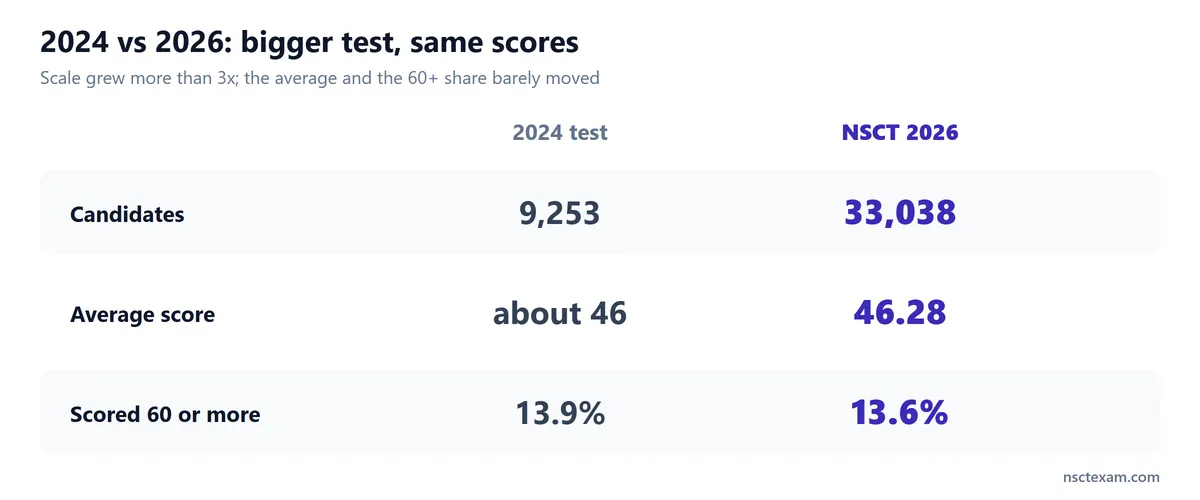
| Measure | 2024 Centralized Test for IT Graduates | NSCT 2026 |
|---|---|---|
| Candidates assessed | 9,253 | 33,038 |
| National average | about 46/100 | 46.28/100 (about 46) |
| Peak score bracket | 40–49 | 40–49 (10,324 candidates) |
| Share scoring 60 or more | about 13.9% | 13.6% |
| Shape after 60 marks | Sharp drop-off | Sharp drop-off |
HEC describes the growth as "nearly 250%". Put simply, 2026 had more than three and a half times as many candidates as 2024 (our arithmetic from HEC's two figures).
Scale: from 9,253 to 33,038 candidates
The 2024 test assessed 9,253 candidates. The 2026 NSCT followed a much larger funnel, which the report sets out step by step: 57,241 candidate records were uploaded, 46,155 students started sign-up, 40,784 completed registration and 33,038 appeared.
One likely reason, in our reading, is the test's new status. HEC announced in March 2026 that universities would be placed into performance tiers based on their students' results, and that institutions failing to facilitate registration would be placed below the lowest tier. That gave every university a reason to register its whole cohort.
Scores: the same curve twice
The most striking finding is how little the score pattern moved. In both years, the most common bracket was 40–49, the average sat around 46/100, and only about one candidate in seven crossed 60.
The 60+ share was actually slightly lower in 2026 (13.6%) than in 2024 (about 13.9%). The gap is small, and HEC does not claim it is significant, but it shows there was no improvement at the top end either.
For 2026, the report adds detail that it does not give for 2024. On HEC's grade scale, 61.4% of 2026 candidates fell in the F bracket, and D and F together came to nearly 83%. Read more on NSCT 2026 results.
Universities: a reshuffle at the top
The report compares the top 20 universities by pass percentage in each year.
| University | 2024 pass rate | 2026 pass rate |
|---|---|---|
| National University of Computer and Emerging Sciences (FAST) | 94.0% | 89.5% |
| National University of Sciences & Technology (NUST) | 90.0% | 89.2% |
| University of Engineering and Technology (UET), Lahore | 70.0% | 82.1% |
| Habib University | Not in 2024 top 20 | 96.5% |
In 2024, FAST (94.0%) and NUST (90.0%) were the clear leaders, and the top-20 list ended with International Islamic University at 40.0%. In 2026, Habib University led at 96.5%, followed by the Information Technology University of the Punjab at 90.4%. HEC attributes FAST's fall "primarily" to the average scores of the many FAST campuses that took part. The full 2026 table is on top universities in NSCT 2026.
What about the format?
HEC's report compares scale, scores and university rankings. It does not describe the format of the 2024 test, such as its duration, sections or question style, and we have not found an official HEC page that does. We therefore do not compare formats here.
For 2026, the format facts are official: HEC described the NSCT as computer-based, and the syllabus is the ten Areas of Competencies with fixed weightage. See NSCT test pattern.
What this means for you
Two tests, two very different cohorts, one result: the peak sits at 40–49 and few candidates pass 60. The lesson is that the national average is not moving on its own. If you want to be in the top seventh, you have to prepare differently from the typical candidate, with timed practice across all ten areas rather than revision of your favourite subjects.
What is not officially confirmed
HEC has not officially announced the NSCT 2027 test dates or registration dates yet. HEC has also not officially announced a passing mark, and no official past papers exist for either the 2024 test or the NSCT. Check nsct.hec.gov.pk and your university's focal person.
FAQs
What is NSCT HEC?
The NSCT is HEC's National Skills Competency Test, a free, computer-based test for 7th and 8th semester computing students, conducted by Virtual University. HEC uses it to benchmark students' IT skills against industry needs and to place universities into performance tiers. Its predecessor was the 2024 HEC Centralized Test for IT Graduates.
Is the NSCT the same as HEC's 2024 IT graduates test?
No. HEC treats them as separate tests: the 2024 HEC Centralized Test for IT Graduates and the 2026 National Skill Competency Test. HEC's report compares them as earlier and later national assessments. The NSCT was much larger, with 33,038 candidates against 9,253.
Did students score better in NSCT 2026 than in 2024?
No. HEC's report says the competency curve was "strikingly identical". The average was about 46/100 in both years, the peak bracket was 40–49 both times, and the share scoring 60 or more was about 13.9% in 2024 and 13.6% in 2026.
Are there past papers from the 2024 test?
No official past papers from the 2024 test or from NSCT 2026 have been published by HEC. Pages that claim to have them are not official. Use practice MCQs built on the official competency areas instead.
What are the NSCT HEC passing marks?
HEC has not officially announced a passing mark. Its report gives pass percentages and HEC grade brackets, but it does not publish a single cut-off score. Check nsct.hec.gov.pk and your university's focal person.
Next step
Beat the average by practising the way the test works. Try the NSCT MCQs and then a full, timed NSCT mock test.