Normalization Practice for the NSCT: Keys, Closures and Normal Forms
Normalisation practice questions give you a relation such as R(A, B, C, D, E) and a set of functional dependencies (FDs), then ask for a closure, the candidate keys, the highest normal form or whether a decomposition is lossless. Each one is a short, mechanical procedure, and it pays to learn it: Databases carries 10% of the NSCT according to HEC's Areas of Competencies, and candidates averaged only 42.3% accuracy there in 2026, per the HEC NSCT report.
The official Database Design & Normalization topic defines 1NF to BCNF. This page drills the calculations. Every closure, key and normal form below was computed by a Python script, not by hand. Keys and superkeys are covered in Relational Database Concepts.
The method, step by step
- Classify the attributes. Mark each one as left-only (appears only on FD left sides, or in no FD at all), right-only, or both.
- Start the key with every left-only attribute. They are in every candidate key. Right-only attributes are in none.
- Compute the closure of that starting set. If it is the whole of R, it is the only candidate key.
- Otherwise add "both" attributes one at a time, then two at a time, and keep every minimal set whose closure is R.
- List the prime attributes, meaning those in any candidate key.
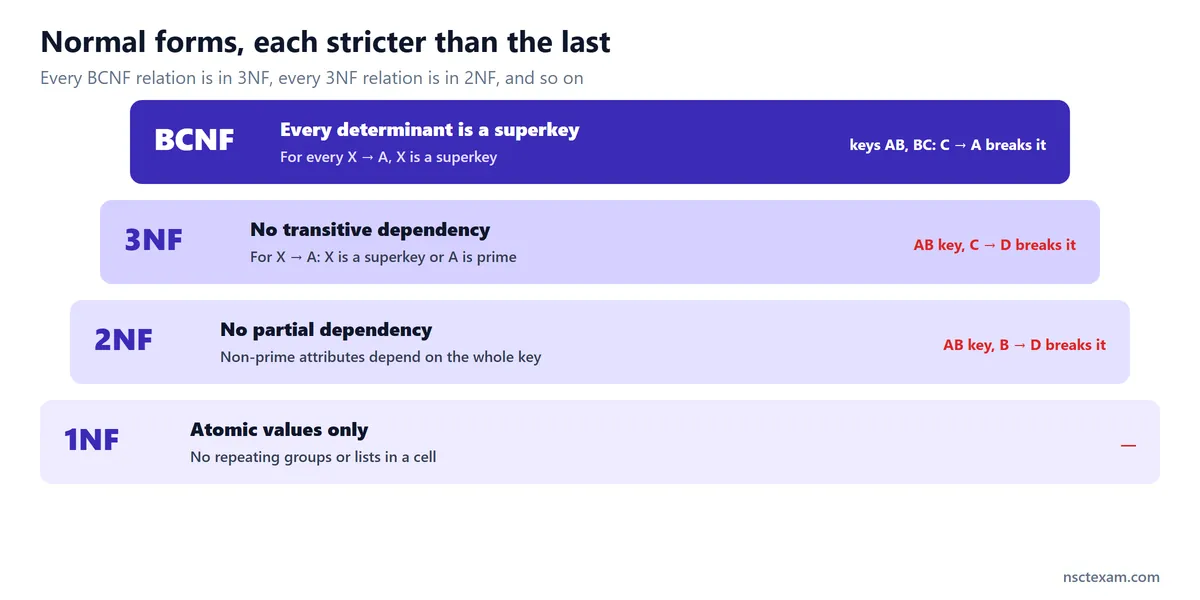
- Test each FD X → A, from the highest normal form down: - BCNF: X is a superkey. - 3NF: X is a superkey, or A is prime. - 2NF: no non-prime A depends on a proper subset of a candidate key.
Attribute closure
The closure X⁺ is every attribute X determines. Start with X and keep firing any FD whose left side is already inside the set.
Given: R(A, B, C, D, E, F), F = {A → B, C → D, BD → E, E → F}. Find (AC)⁺.
| Step | FD fired | Set |
|---|---|---|
| Start | none | {A, C} |
| 1 | A → B | {A, B, C} |
| 2 | C → D | {A, B, C, D} |
| 3 | BD → E | {A, B, C, D, E} |
| 4 | E → F | {A, B, C, D, E, F} |
Answer: (AC)⁺ is all of R, so AC is a superkey. Neither half works alone, because A⁺ = {A, B} and C⁺ = {C, D}. So AC is also a candidate key.
Finding candidate keys
Given: R(A, B, C, D, E), F = {A → B, BC → E, DE → A}.
| Attribute | Left side | Right side | Class |
|---|---|---|---|
| A | yes | yes | both |
| B | yes | yes | both |
| C | yes | no | left-only |
| D | yes | no | left-only |
| E | yes | yes | both |
C and D must be in every key. (CD)⁺ = {C, D}, which is not enough, so try adding one "both" attribute:
| Candidate | Closure | Key? |
|---|---|---|
| ACD | A → B, BC → E gives | yes |
| BCD | BC → E, DE → A gives | yes |
| CDE | DE → A, A → B gives | yes |
Answer: three candidate keys, ACD, BCD and CDE. Every attribute is prime, so this relation is automatically in 3NF. It is not in BCNF, because A → B has a non-superkey left side.
Deciding the highest normal form
Find the keys first, then test every FD. The script's verdicts:
| Relation and FDs | Keys | Violation found | Highest NF |
|---|---|---|---|
| R(A, B, C, D, E): AB → C, B → D, D → E | AB | B → D: non-prime D depends on part of key AB | 1NF |
| R(A, B, C, D, E): AB → C, C → D, D → E | AB | C → D: non-key to non-prime (transitive) | 2NF |
| R(A, B, C, D, E): AB → CDE, C → A | AB, BC | C → A: C not a superkey, but A is prime | 3NF |
| R(A, B, C, D): A → BCD, BC → A | A, BC | none; both left sides are keys | BCNF |
Notice in the first row that the transitive chain B → D → E does not matter once B → D has already failed 2NF. Always report the highest form that every FD satisfies.
Lossless join and dependency preservation
A split of R into R1 and R2 is lossless when the common attributes determine all of R1 or all of R2. Otherwise joining the parts back creates spurious tuples, which are rows that were never in R.
Lossy example: R(A, B, C) with only A → B, holding the rows (1, x, p) and (2, x, q). Split it into (A, B) and (B, C). The common attribute B determines neither side. Joining the parts on B gives four rows: (1, x, p), (1, x, q), (2, x, p) and (2, x, q). Two of these are spurious.
Lossless but not preserving: R(A, B, C, D, E) with AB → CDE and C → A, keys AB and BC. To reach BCNF, split on C → A:
| Part | Key | Normal form |
|---|---|---|
| R1(C, A) | C | BCNF |
| R2(B, C, D, E) | BC | BCNF |
The common attribute C determines A, so the split is lossless. But AB → CDE now spans both tables and cannot be checked inside either one, so a dependency is lost. That is the classic BCNF trade-off. 3NF synthesis would keep R whole, because R is already in 3NF.
Minimal cover
A minimal (canonical) cover has single attributes on the right, no extraneous left-side attributes and no redundant FDs.
Given: F = {AB → C, A → C, C → D, AD → B}.
- Split the right sides. They are already single attributes.
- In AB → C, B is extraneous because A⁺ already contains C. It becomes A → C, a duplicate.
- In AD → B, D is extraneous because A → C → D, so A alone already reaches D. It becomes A → B.
- Check redundancy. None of A → C, C → D and A → B can be derived from the other two.
Answer: {A → B, A → C, C → D}.
Speed tricks
- Left-only attributes go in every key and right-only attributes go in none. This often finds the key at once.
- If every attribute is prime, the relation is at least in 3NF. Only BCNF can still fail.
- If every candidate key is a single attribute, 2NF is automatic, because a single attribute has no proper subset to depend on.
- Every two-attribute relation is in BCNF.
- Superkey count: if K is the only key, R has 2^(n − |K|) superkeys. With more keys, use inclusion-exclusion.
Common mistakes
- Stopping the closure too early. Keep looping until a full pass adds nothing.
- Reporting a superkey such as ABC as a candidate key without checking that it is minimal.
- Forgetting attributes that appear in no FD at all. They must be in every key.
- Calling X → A a 3NF violation when A is prime.
- Testing only the given FDs for BCNF after a decomposition. You must also test FDs implied on the smaller table.
- Treating any shared attribute as enough for a lossless join. The shared attributes must determine one whole side.
Practice set
- R(P, Q, R, S, T), F = {P → Q, QR → S, S → T}. What is (QR)⁺?
- For the same relation, what is the candidate key?
- What is its highest normal form?
- R(A, B, C), F = {A → B, B → C}. What is the highest normal form?
- R(A, B, C) has the single candidate key A. How many superkeys does it have?
- R(A, B, C, D, E, F), F = {A → C, B → D, CD → E, E → F}. Find the key and the highest normal form.
- R(A, B, C), F = {B → C}. Is the split into (A, B) and (B, C) lossless?
- R(A, B, C), F = {A → B, B → C}, split into (B, C) and (A, B). Is it lossless, and are the dependencies preserved?
Show answers
- {Q, R, S, T}. QR → S, then S → T. P is never produced.
- PR. P and R are left-only, and (PR)⁺ = {P, Q, R, S, T}.
- 1NF. P → Q makes the non-prime Q depend on part of the key PR.
- 2NF. The key is A (a single attribute), but B → C is transitive.
- 4. 2^(3 − 1): A, AB, AC and ABC.
- Key AB, 1NF. A → C is a partial dependency.
- Lossless. The common attribute B determines C, which covers (B, C).
- Lossless and preserving. B → C covers (B, C), and A → B and B → C each sit inside one part.
Practise: 20 questions
FAQs
Can a relation have more than one candidate key?
Yes. R(A, B, C, D, E) with A → B, BC → E and DE → A has three: ACD, BCD and CDE. Any minimal set whose closure equals R is a candidate key. The designer then picks one as the primary key; the others become alternate keys.
Is every relation in BCNF also in 3NF?
Yes. BCNF demands a superkey on the left of every non-trivial FD, which automatically satisfies the 3NF rule "superkey or prime right side". The reverse fails: a relation can be in 3NF but not BCNF when a non-superkey determines a prime attribute.
Why not always decompose to BCNF?
Because BCNF decomposition can lose dependencies. The constraint then has to be checked with a join or a trigger on every update. Elmasri-Navathe and Silberschatz both suggest settling for 3NF when reaching BCNF would lose an important dependency, because 3NF synthesis is always lossless and dependency-preserving.
How do I check an FD against sample data?
Look for two rows that agree on the left side but differ on the right. One such pair disproves the FD. No amount of sample data can prove an FD holds, because FDs are rules about every valid state of the relation, not just the rows you can see.
Next step
Go back to the official Database Design & Normalization topic, then try ACID properties practice. See every Databases topic on the Databases MCQs hub, or put it all together in an NSCT mock test.